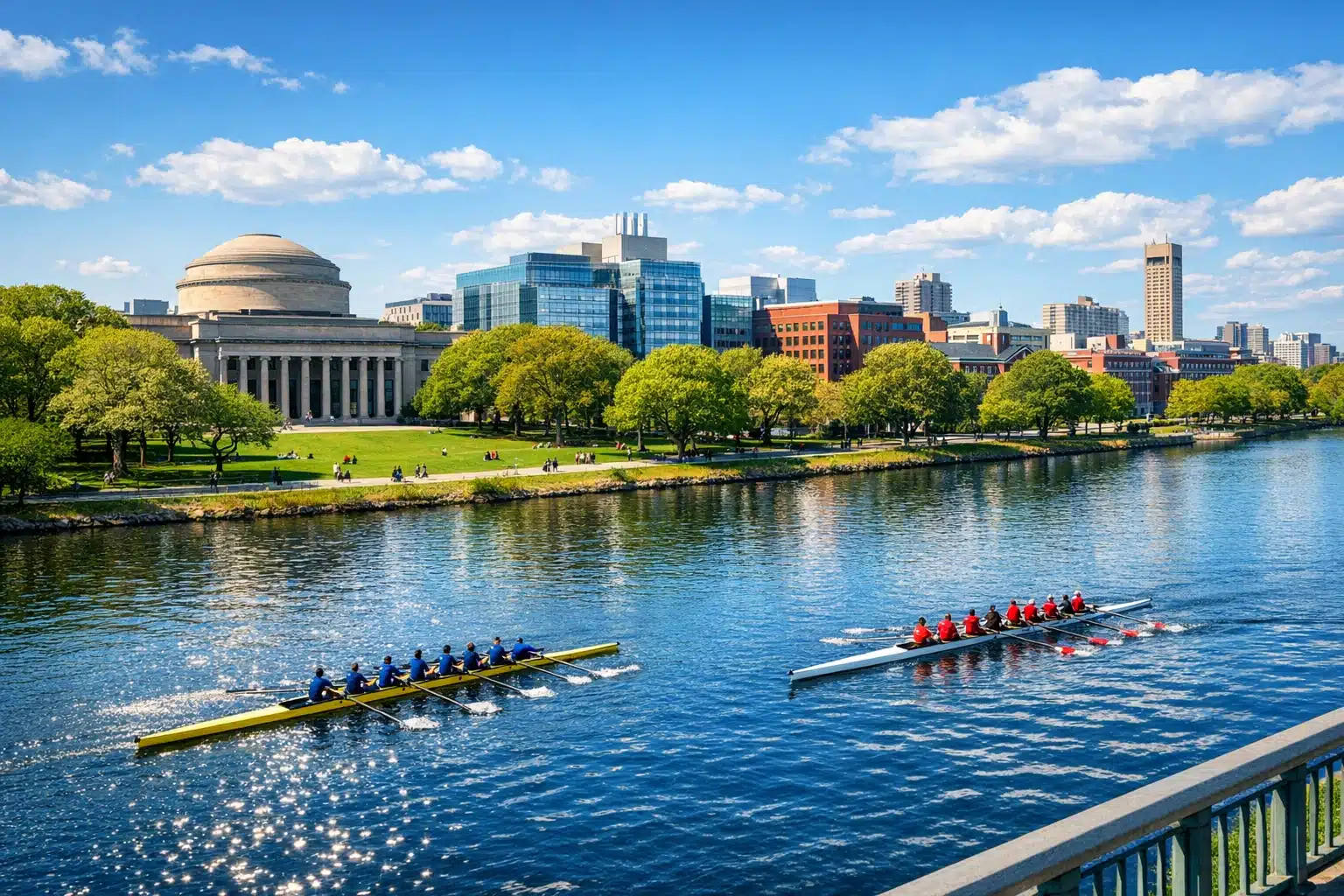
 Artificially generated image
 Top 5 Colleges In Massachusetts
Few places in the United States concentrate academic influence the way Massachusetts does. Within a relatively compact map, students can find world-class laboratories, seminar rooms built for deep discussion, powerful alumni networks, and cities filled with internships. That variety is exciting, but it can also make college research harder than expected. This article narrows the search to five exceptional institutions and explains what each one offers beyond a famous name.
Outline
- How Harvard University stands out through scale, prestige, research access, and financial aid.
- Why MIT remains a defining choice for students drawn to science, engineering, design, and entrepreneurship.
- What makes Tufts University attractive for globally minded students seeking balance between rigor and community.
- How Amherst College delivers a highly personalized liberal arts experience with unusual curricular freedom.
- Why Williams College continues to appeal to students who want tutorial-style learning and a close-knit campus.
Harvard University
Harvard University is usually the first Massachusetts institution that comes to mind, and for understandable reasons. Founded in 1636, it is the oldest institution of higher education in the United States, but its appeal is not merely historical. Harvard remains influential because it combines enormous academic breadth with the resources of a modern global university. For undergraduates, that means access to hundreds of courses across the humanities, social sciences, natural sciences, and applied fields, along with libraries, museums, research centers, and a faculty that includes many of the most cited scholars in their disciplines. The campus in Cambridge also places students within one of the most intellectually active urban areas in the country, where ideas seem to drift through the air like autumn leaves.
What distinguishes Harvard from many other elite schools is scale paired with opportunity. A student interested in government can take advantage of proximity to the Kennedy School and Boston-area public institutions. Someone pursuing biology may find lab openings through major research initiatives. A writer can move between literature courses, student publications, theater productions, and visiting lectures with remarkable ease. Harvard College also uses the residential House system, which helps shrink a large institution into smaller communities. That structure matters because one common concern about globally recognized universities is that undergraduates will feel anonymous. Harvard tries to counter that by organizing advising, dining, traditions, and peer networks around the Houses.
Another major strength is financial aid. Harvard has built a strong reputation for making attendance more accessible to families across a wide range of income levels, and for many students the real cost may be lower than the sticker price suggests. Of course, admission is extremely selective, so affordability only matters once a student gets in. Even so, Harvard deserves a place near the top of any Massachusetts list because it offers unusual academic flexibility, elite research access, and long-term name recognition in nearly every field.
- Best for students who want broad academic choice and significant research resources.
- Especially strong in economics, government, biology, history, law-related pathways, and interdisciplinary study.
- A good fit for ambitious students comfortable in a fast-moving and highly accomplished peer environment.
Compared with MIT, Harvard tends to feel broader and less centered on technical disciplines. Compared with Amherst or Williams, it offers more institutional scale and more professional pathways, though often with less intimacy in the classroom experience. For students who want a powerful combination of tradition, flexibility, and global reach, Harvard remains one of the strongest college options in Massachusetts.
Massachusetts Institute of Technology
The Massachusetts Institute of Technology, better known as MIT, is one of the clearest examples of a school whose reputation is both enormous and well earned. Located in Cambridge along the Charles River, MIT has become almost synonymous with innovation in science, engineering, computing, economics, and applied research. Yet one of the most important things prospective students should understand is that MIT is not simply a place for textbook brilliance. It is a place for building, testing, failing, revising, and trying again. The culture prizes experimentation. Ideas do not stay in notebooks for long; they tend to become prototypes, startups, lab projects, policy models, or code.
Undergraduate life at MIT is shaped by this hands-on spirit. The institute’s Undergraduate Research Opportunities Program has long been a signature feature, allowing students to work directly with faculty on active research. That is a major advantage for students who want early exposure to serious technical or scientific work rather than waiting until graduate school. MIT is especially strong for engineering, computer science, mathematics, physics, and related fields, but it would be a mistake to overlook its humanities, arts, and social sciences offerings. In fact, MIT deliberately requires students to engage outside their technical concentration, reflecting the idea that innovation works better when paired with communication, ethics, and historical awareness.
MIT also differs from many highly selective universities in tone. It can be intense, but it is often described as collaborative rather than purely competitive. Students swap problem-solving strategies, launch clubs that turn into companies, and learn to treat difficult coursework as a shared challenge. Around campus, the atmosphere can feel equal parts laboratory and playground. One hallway may lead to robotics, another to architecture, and another to students discussing climate policy over coffee. That sense of motion is part of the institution’s identity.
- Best for students who love quantitative thinking and learning by doing.
- Particularly strong in engineering, computing, economics, physics, and entrepreneurship.
- Ideal for applicants who want a deeply technical education without losing access to interdisciplinary exploration.
Compared with Harvard, MIT is more specialized in its cultural center of gravity, even though its curriculum is broader than outsiders often assume. Compared with Tufts, it is more research-intensive and technical. Compared with Amherst and Williams, it offers less of a classic liberal arts rhythm but far more immersion in high-level scientific infrastructure. For future engineers, programmers, inventors, and analytically minded problem-solvers, MIT is not just one of the top colleges in Massachusetts; it is one of the defining institutions of higher education anywhere.
Tufts University
Tufts University often sits in an interesting and valuable middle ground within Massachusetts higher education. It does not have the same mythic public image as Harvard or MIT, but that is part of why it deserves attention. Tufts has built a strong identity around intellectual flexibility, global engagement, and a campus culture that many students find more approachable than some of the state’s more intimidating giants. Located in Medford and Somerville, with easy access to Boston, Tufts offers the benefits of a research university while preserving a student-centered atmosphere. It can feel serious without feeling cold, and ambitious without becoming theatrical about it.
Academically, Tufts is known for strengths in international relations, political science, biology, economics, engineering, public health pathways, and interdisciplinary study. The Fletcher School gives the university a notable global policy presence, and that influence often spills into undergraduate interests. Students who care about diplomacy, development, environmental policy, or social impact frequently find Tufts appealing because it connects classroom study to real-world questions. The School of Engineering adds another dimension, making Tufts attractive to students who want technical training in a campus culture that still leans heavily toward broad conversation and cross-disciplinary work.
What makes Tufts especially compelling is balance. It balances urban access with a traditional campus setting. It balances research opportunities with faculty engagement. It balances professional ambition with a somewhat more relaxed social tone than many applicants expect from a highly selective institution. Students often describe the community as curious, involved, and civically minded. That matters because fit is not a soft factor; it shapes whether students thrive. A brilliant school that feels isolating may not serve a student as well as a slightly less famous one that provides the right rhythm, mentorship, and opportunities to participate.
- Best for students who want a research university with strong undergraduate visibility.
- Especially attractive for international relations, political science, biology, engineering, and civic engagement.
- A strong option for students seeking Boston-area access without a purely urban campus experience.
Compared with Harvard and MIT, Tufts is often perceived as less intense in brand pressure, though still highly rigorous. Compared with Boston College, it may feel more internationally oriented and somewhat more interdisciplinary in style. Compared with Amherst and Williams, it offers a larger university framework and more direct proximity to a major metropolitan job market. For students who want challenge, flexibility, and a community that does not require constant self-advertisement, Tufts stands out as one of the most well-rounded colleges in Massachusetts.
Amherst College
Amherst College represents a different kind of excellence from the large research universities that dominate many conversations about prestige. Located in western Massachusetts, Amherst is a small liberal arts college known for exceptional teaching, close faculty relationships, and an open curriculum that gives students unusual freedom to shape their education. That last point is crucial. Unlike schools with extensive core requirements, Amherst allows students to move more directly toward the subjects that genuinely excite them. For some students, that is liberating in the best possible way. Instead of spending years navigating a prescribed map, they get to build one. The result can feel less like checking boxes and more like designing an intellectual life.
The academic environment at Amherst is rigorous, but it is rigorous in a highly personal format. Class sizes tend to be small, discussion is central, and professors are deeply involved in undergraduate teaching. Students are not simply one layer beneath graduate researchers because Amherst has no graduate programs competing for faculty attention in the same way a major research university does. That makes mentorship a major advantage. A student in political science, English, mathematics, neuroscience, or history is likely to receive detailed feedback and meaningful advising rather than only occasional contact. For many applicants, especially those who learn best through conversation and writing, that is a serious benefit rather than a secondary feature.
Amherst also participates in the Five College Consortium, which includes Smith College, Mount Holyoke College, Hampshire College, and the University of Massachusetts Amherst. This arrangement expands course access and social options while preserving the close-knit scale of Amherst itself. In practice, students get the intimacy of a small college with some of the variety usually associated with larger institutions. The surrounding Pioneer Valley adds another layer of appeal. It is scenic, intellectually active, and more relaxed than Boston or Cambridge, which can be exactly what some students want.
- Best for students who want small classes, direct faculty access, and a flexible curriculum.
- Especially strong for humanities, social sciences, natural sciences, and students considering graduate study.
- A smart choice for independent learners who value depth over institutional spectacle.
Compared with Harvard, MIT, and Tufts, Amherst offers far more intimacy and far less urban energy. Compared with Williams, it shares many liberal arts strengths, though students often debate differences in culture, setting, and curriculum. If you want an education built around close reading, serious discussion, and the freedom to pursue your interests with precision, Amherst College belongs securely among the top colleges in Massachusetts.
Williams College
Williams College, set in Williamstown in the Berkshire Mountains, is often considered one of the finest liberal arts colleges in the United States. Like Amherst, it delivers small classes, close faculty engagement, and a strong residential community. Yet Williams has its own distinct atmosphere. The setting is more secluded, the visual beauty of the region is a real part of campus life, and the academic experience is shaped by traditions such as the tutorial system, where students work in pairs under faculty guidance in an intensive discussion-based format. If large universities can sometimes feel like a busy airport, Williams often feels more like a mountain observatory: focused, quiet, and full of people looking very carefully at the world.
Academically, Williams is strong across the humanities, social sciences, arts, and sciences, with a particularly notable reputation for economics, political science, English, art history, mathematics, and biology. The college’s size means undergraduates receive exceptional attention, and the tutorial format encourages habits that many universities only promise in brochures: careful preparation, analytical speaking, close writing, and thoughtful disagreement. Those are not flashy skills, but they transfer remarkably well to graduate study, law, consulting, journalism, finance, public service, and many other fields.
Another major strength is campus culture. Williams tends to attract students who are high achieving but not necessarily interested in performing achievement at every moment. Athletics matter, the arts matter, and outdoor life matters too. The Berkshire location gives the college a rhythm that differs sharply from Cambridge or Boston. There is less urban distraction, but also less immediate access to internships during the semester. For some students that is a drawback; for others it is a gift. The campus becomes a place for immersion. Students often speak of the community with unusual loyalty, which suggests the college does not just educate them well but shapes their daily life in a memorable way.
- Best for students who want elite academics in a small, highly engaged residential community.
- Especially attractive for those who value writing, discussion, tutorials, and close mentorship.
- A strong fit for students comfortable in a rural setting with rich arts and outdoor opportunities.
Compared with Amherst, Williams may feel more secluded and more structured in certain traditions, while Amherst may appeal more strongly to students who prioritize the open curriculum. Compared with Harvard, MIT, or Tufts, Williams trades scale and city access for exceptional undergraduate focus. For students who want a deeply personal academic experience with national prestige and a striking natural setting, Williams College earns its place in any serious list of Massachusetts’s best colleges.
Conclusion: How to Choose the Right Massachusetts College
If you are building a college list, the most useful lesson is simple: the best school is not automatically the most famous one. Harvard offers unmatched breadth and influence, MIT thrives on technical creativity, Tufts balances rigor with global awareness, Amherst rewards independent thinkers, and Williams turns close mentorship into an art form. All five are outstanding, but they serve different kinds of students. Your ideal choice depends on whether you want a city or a quieter town, a research university or a liberal arts college, a structured path or more room to design your own.
- Choose Harvard if you want range, prestige, and large-scale opportunity.
- Choose MIT if you want intense hands-on learning in STEM and innovation.
- Choose Tufts if you want flexibility, international outlook, and strong community.
- Choose Amherst if you want small classes and unusual curricular freedom.
- Choose Williams if you want discussion-driven learning in a close residential setting.
For students and families, the smartest next step is to move beyond rankings and ask better questions: Where will I learn best, feel challenged, and actually enjoy the next four years? Massachusetts gives you excellent answers to that question. The real task is choosing the one that sounds less like a trophy and more like a future.