Permeable Pavers: Costs, Benefits & How to Buy Now
Driveways rarely get much attention until cracks spread, puddles linger, and curb appeal begins to slip. That helps explain why permeable pavers are gaining ground with homeowners who want a surface that looks refined, manages rain more intelligently, and can support long-term property value. Instead of forcing stormwater to race away, this system allows it to pass through the surface into a prepared stone base below. The result is a driveway that feels less like a plain slab and more like a carefully planned part of the home.
Article Outline and Why This Driveway Trend Matters
Before diving into costs and materials, it helps to map the road ahead. This article covers five core questions: what permeable pavers are, how they compare with plain concrete, what they typically cost, which benefits matter most, and how to buy with confidence. Think of it as a practical field guide for a part of the home that is often overlooked, even though it is one of the first things people see and one of the hardest-working surfaces on the property. A driveway is not just a place to park. It carries vehicle weight, shapes curb appeal, affects drainage, and influences how clean or messy the front of the house feels after a storm.
The reason this topic is so relevant now is simple: homeowners are asking more from exterior surfaces. A standard concrete driveway can still do the job, but it often sends water into the street, contributes to puddling, and offers limited flexibility once cracks show up. Permeable pavers answer a broader list of needs. They can look more custom, allow water to move through the joints or openings, and make spot repairs easier because individual units can often be lifted and replaced instead of forcing a large patch. In areas with heavier rain, freeze-thaw cycles, or growing interest in low-impact landscaping, that combination is especially appealing.
There is also a larger property-planning reason behind the trend. More municipalities and builders are paying closer attention to stormwater management. Impervious surfaces such as traditional concrete and asphalt can increase runoff, which may overwhelm drains or move water toward garages, sidewalks, or foundations if grading is poor. Permeable systems help slow that chain reaction. They do not solve every drainage issue on their own, but they can become a useful part of a smarter site plan. For many households, the choice is no longer just about whether a driveway is gray, tan, or patterned. It is about whether it can do more than sit there looking hard and flat.
That is why the driveway style taking over is not merely a design fad. It reflects a shift in priorities: better drainage, stronger curb appeal, more material choices, and a willingness to invest in surfaces that work with the landscape rather than against it. In the sections that follow, we will move from the big picture to the practical details, including where permeable pavers shine, where they require care, and how to tell whether the numbers make sense for your home.
What Permeable Pavers Are and How They Compare With Plain Concrete
Permeable pavers are a driveway system designed to let water pass through the surface rather than run off it immediately. In many installations, the visible top layer consists of concrete or stone pavers laid with carefully sized joints filled with clean aggregate. Beneath that sits an open-graded stone base that acts like a reservoir, temporarily holding water and allowing it to soak into the soil below. Some sites may also need edge restraints, geotextile separation, or an underdrain if the native soil drains slowly. The visible surface is only part of the story. The performance comes from the entire layered assembly.
That makes permeable pavers very different from plain poured concrete. Traditional concrete creates a largely impervious surface. Rainwater usually sheets across it, and unless grading and nearby drains are excellent, the water has to go somewhere else. On some properties that means harmless runoff into a suitable drainage area. On others, it means standing water, splashback, erosion along edges, or extra stress on site drainage. Permeable pavers change the equation by managing water where it lands. It is a quieter kind of engineering, hidden under the tires but noticeable after a heavy rain.
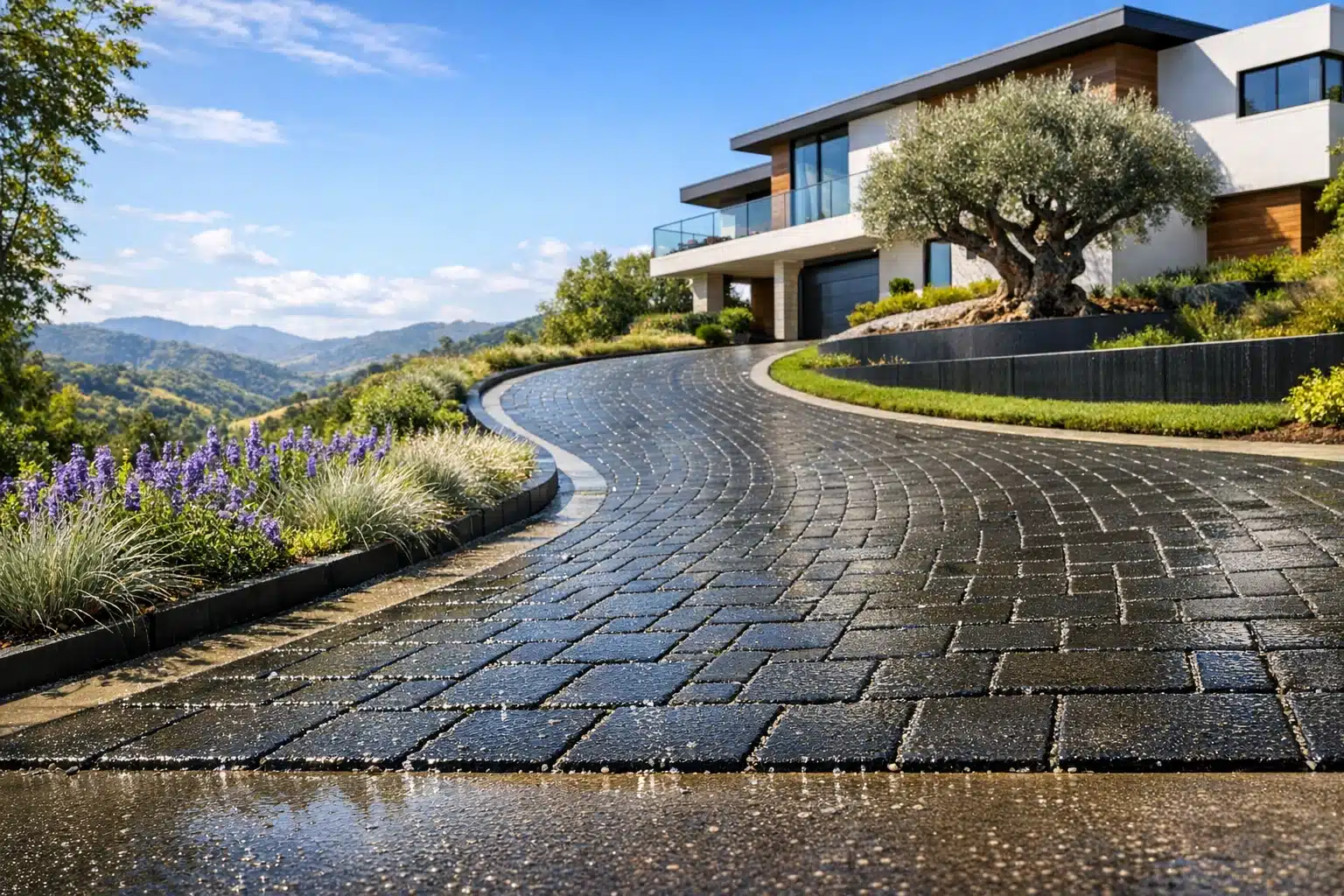
From a style perspective, the comparison is just as interesting. Plain concrete offers a clean, simple look and can be broom-finished, stamped, or colored. Yet it often reads as one large slab. Pavers, by contrast, can create a more tailored appearance through pattern, border choices, color variation, and texture. A driveway can feel like an extension of the landscape design instead of a separate construction project. For homeowners trying to improve curb appeal without making the house look overly formal, that balance can be a big advantage.
There are practical differences in performance too. Concrete is durable, but when it cracks, repair is often visually obvious. Patches can stand out. Control joints help direct cracking, not eliminate it. Permeable pavers spread loads across many units, and if a section settles or a utility line must be accessed later, that area can often be taken up and reset. This repairability is one reason people call pavers a smarter driveway choice. It is not because concrete is obsolete. It is because pavers provide more flexibility over time.
Still, permeable pavers are not automatically the right answer for every site. Soil type, slope, local weather, vehicle loads, and installation quality all matter. A poorly built permeable system can clog or settle, just as a poorly poured slab can crack early. The key takeaway is that permeable pavers are not simply decorative blocks with gaps. They are a purpose-built drainage surface that blends appearance and function in ways a standard concrete driveway usually cannot.
Costs, Installation Factors, and Long-Term Value
The question most homeowners ask next is the obvious one: what does it cost? In many U.S. markets, a permeable paver driveway commonly lands above the price of a basic poured concrete driveway because the installation is more involved. While local labor rates, excavation conditions, and paver selection can shift the numbers substantially, a rough installed range for permeable pavers is often about 15 to 40 dollars per square foot. By comparison, a basic concrete driveway might fall closer to roughly 8 to 18 dollars per square foot, with decorative concrete climbing higher. These are broad planning numbers rather than firm quotes, but they explain why sticker shock sometimes appears early in the conversation.
So where does the extra cost come from? Much of it is below the surface. Permeable systems usually require careful excavation, a properly compacted open-graded base, edge restraints, clean joint stone, and attention to grading and drainage details. The pavers themselves can also vary widely in price depending on thickness, finish, color, brand, and pattern. A simple rectangular concrete paver will usually cost less than a premium architectural unit with multiple sizes and a designer finish. Site constraints add another layer. Tight access, removal of an old driveway, tree roots, poor subsoil, and steep grades can all increase labor and material needs.
For a real-world planning example, imagine a 600-square-foot two-car driveway. At 15 dollars per square foot, the project would be around 9,000 dollars. At 30 dollars per square foot, it would reach 18,000 dollars. If the site needs deeper excavation, drainage upgrades, or premium stone choices, the total can climb further. These numbers do not mean the project is overpriced. They mean the driveway is being built as both a finished surface and a water-management system.
Long-term value is where the conversation becomes more balanced. Permeable pavers may reduce drainage headaches, improve curb appeal, and allow easier sectional repair. Individual units can often be replaced if stained or damaged. Some buyers also appreciate the upgraded look and practical stormwater benefit, which can support perceived property value even if it is hard to assign an exact resale premium. Concrete may cost less at the start, but replacement or visible repair years later can narrow the gap in some situations.
Maintenance costs should also be part of the budget. Permeable pavers are not maintenance-free. They may need occasional sweeping, replenishment of joint aggregate, and periodic vacuuming or professional cleaning to help preserve infiltration. Yet that upkeep is usually manageable if the system is installed properly and leaves, silt, and sand are controlled. In short, the higher initial price reflects added complexity, but for many households the package offers enough function and flexibility to justify the investment.
Benefits, Trade-Offs, and Why Homeowners Are Making the Switch
The strongest case for permeable pavers is that they solve more than one problem at once. They improve the appearance of a driveway, help manage stormwater, and can make future repairs less disruptive. That combination is a big reason homeowners are moving away from plain concrete, especially when they are already planning a major exterior update. It feels like a smarter use of the same square footage. Instead of one hard surface doing one basic job, the driveway starts acting like part of the landscape system.
The drainage benefit is often the headliner. By allowing water to filter through the surface and into a stone base, permeable pavers can reduce runoff and help limit puddling. In the right setting, that may mean fewer slick spots near the garage, less water racing across walkways, and reduced erosion along the driveway edge. In freeze-thaw climates, better drainage can also help by reducing the amount of standing water that repeatedly freezes at the surface. It is not magic, and good design still matters, but it is a meaningful upgrade from a fully impervious slab.
Appearance is another major factor. A plain concrete driveway can look neat when new, yet it often ages in a straightforward way: hairline cracks, stains, and color variation become part of the picture. Pavers can age more gracefully because variation is built into the design from the start. A few leaves in the joints or subtle shifts in tone tend to feel natural rather than like visual damage. The driveway becomes more like a tailored entry court than a construction leftover. That is a small emotional shift, but homeowners notice it every time they pull in after a long day.
There are trade-offs, and they deserve equal attention. Permeable pavers need correct installation to perform well. They can clog if sediment builds up, so nearby bare soil, heavy leaf litter, or careless use of sand can reduce performance. Snow removal requires some care as well, especially if the plow blade is set too low and catches the paver edges. Weeds are another common concern. A well-built system is not automatically overrun, but neglect can allow organic debris to collect and invite growth over time.
For quick reference, the main advantages often include:
• better stormwater control
• stronger curb appeal and design flexibility
• easier spot repair than large concrete patches
• potential compatibility with broader landscape drainage plans
The main cautions usually include:
• higher upfront cost
• more reliance on skilled installation
• periodic maintenance to prevent clogging
• site limitations on certain soils or steep slopes
That honest mix is exactly why the switch is gaining momentum. Homeowners are not choosing permeable pavers because they are trendy alone. They are choosing them because the benefits are tangible and the trade-offs are understandable.
How to Buy Now and Final Advice for Homeowners
If you are interested in permeable pavers, buying well matters as much as choosing the material itself. The smartest first step is to evaluate the site before falling in love with a color or pattern. Soil conditions, slope, drainage paths, local climate, and daily vehicle use should shape the design. A driveway that handles two sedans in a mild climate may need a different base strategy than one that sees larger vehicles, freeze-thaw cycles, or runoff from adjacent roofs and hardscapes. In other words, do not shop for pavers as if you are only buying a surface finish. You are buying a system.
When requesting quotes, ask contractors questions that go below the decorative layer. What base depth are they recommending, and why? Will the project include excavation and disposal of the old driveway? How will edges be restrained? What joint material will be used? Is the installer experienced with permeable systems specifically, not just standard pavers? Can they explain how water will move through the assembly and where overflow goes during heavy storms? Clear answers matter because two bids can look similar on paper while describing very different levels of preparation.
Material choice should also match the property style. Concrete permeable interlocking pavers are among the most common choices because they balance appearance, availability, and structural performance. Natural stone can look beautiful but may cost more. Grid-style systems filled with gravel can be more understated and practical in some settings, though they create a different visual effect. If your home has a clean modern exterior, larger-format pavers in a restrained palette may fit well. If the architecture is more traditional, mixed tones and bordered patterns can soften the look. The best driveway is not the one that shouts the loudest. It is the one that belongs.
There are also a few red flags worth remembering:
• very low bids that skip discussion of base preparation
• no mention of maintenance after installation
• vague claims that the system works on any site without evaluation
• no portfolio of comparable driveway projects
For homeowners deciding whether to switch from plain concrete, the simplest test is this: do you want a driveway that merely covers ground, or one that contributes to drainage, appearance, and repair flexibility at the same time? If budget is the top priority and the site drains well, a conventional driveway may still be the right fit. But if you are already investing in landscaping, exterior updates, or better water management, permeable pavers often make a strong case.
Final takeaway for the homeowner: this driveway style is taking over because it answers modern expectations without pretending to be effortless or cheap. It asks for more planning upfront, yet it gives back through smarter drainage, adaptable design, and a more finished first impression. If you compare bids carefully, choose a contractor who understands the full system, and match the product to your site, permeable pavers can be one of the most practical exterior upgrades you make.