Harbor Freight Tools Warehouse Clearance: A Comprehensive Guide
Why Warehouse Clearance Matters and What This Guide Covers
Warehouse clearance is where retail strategy becomes visible to everyday shoppers: shelves shift, prices bend, and slow-moving stock suddenly turns into opportunity. For a chain such as Harbor Freight Tools, clearance events can reveal how product cycles, distribution timing, and store-level demand interact behind the scenes. Understanding that process helps buyers separate genuine value from impulse buying. It also offers a practical window into how modern retail inventory systems really work.
Harbor Freight Tools is widely known in the United States as a value-oriented tool and equipment retailer with a broad range of hand tools, power tools, shop supplies, automotive gear, storage products, and seasonal items. That makes it a useful example for discussing warehouse clearance because the business sits at the intersection of price sensitivity, high product variety, and practical demand. A clearance event at a tool retailer does not appear out of thin air. It is usually the visible result of decisions about purchasing, replenishment, storage costs, incoming shipments, packaging changes, and shelf space. In other words, the markdown tag is only the last sentence in a much longer story.
This guide follows that story in a logical order. It begins with a simple question: what does “warehouse clearance” usually mean in a retail setting, and how is it different from a regular promotion? It then moves into the mechanics of inventory management, where terms such as reorder points, overstock, SKU productivity, and carrying cost start to matter. After that, it looks at distribution practices, including the path from supplier to warehouse to store, and how those systems can quietly shape what ends up on a clearance rack.
- What shoppers often mean when they say “warehouse clearance”
- How markdowns differ from coupons, temporary sales, and open-box offers
- Why some tools are cleared out while others rarely linger
- How warehousing and replenishment choices influence store pricing
- What practical lessons buyers can take from these patterns
One important note keeps the discussion grounded: not every internal operational detail of any retailer is publicly disclosed. So while some observations come from visible store behavior and common retail practice, the broader analysis is based on standard inventory and distribution methods used across large multi-store chains. That is not a limitation so much as a strength. It lets readers understand the structure beneath the signage without needing insider access, and it turns a simple bargain hunt into a sharper view of how retail actually functions.
What “Warehouse Clearance” Usually Means at Harbor Freight Tools
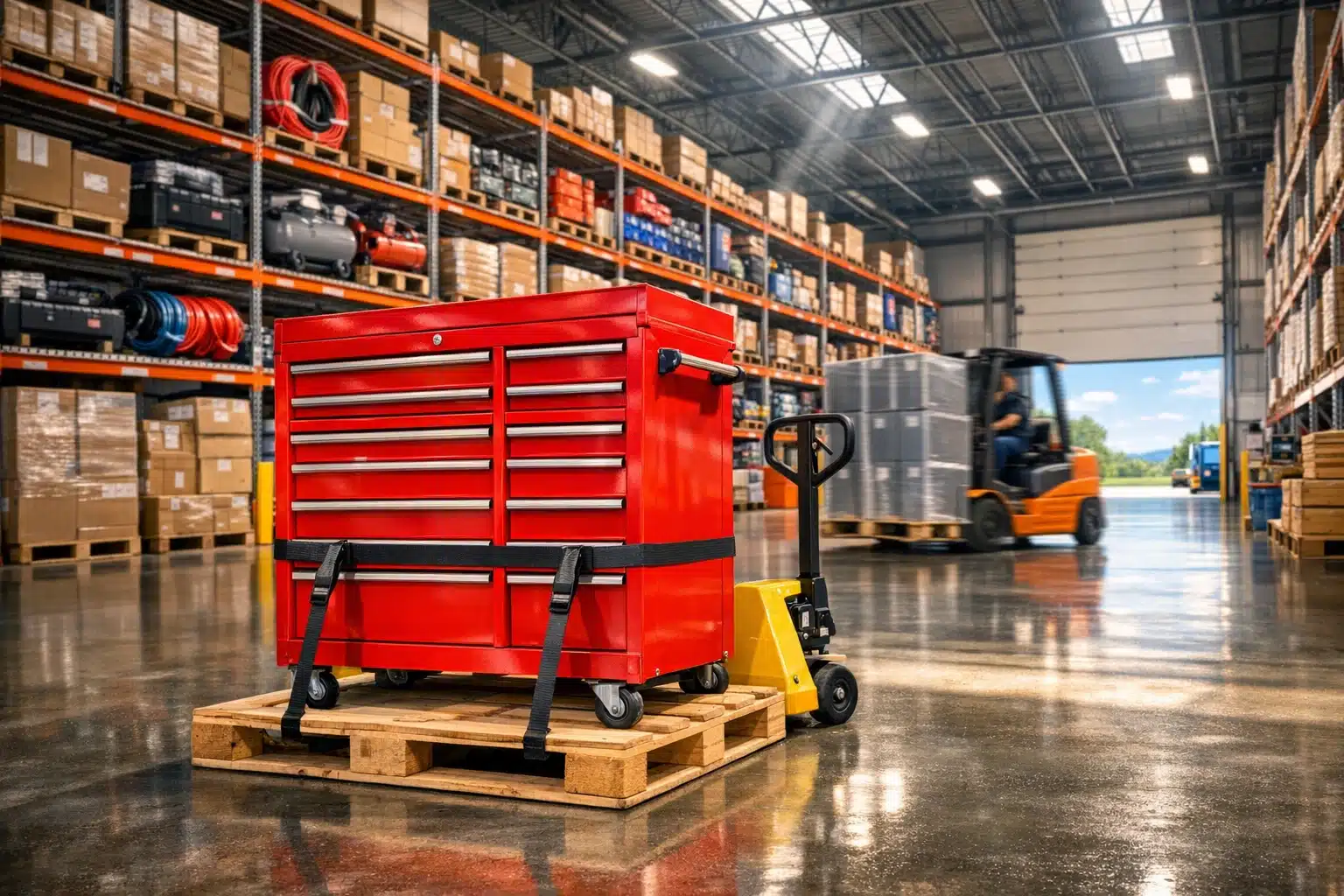
When shoppers hear the phrase “warehouse clearance,” they often picture a dramatic scene: a giant back room stacked to the ceiling, forklifts weaving through narrow lanes, and managers frantically trying to empty space before another convoy of merchandise arrives. The reality is less cinematic but more interesting. In retail, warehouse clearance can refer to several different situations, and not all of them mean a company is desperate to unload product. Quite often, it signals routine inventory discipline.
At a retailer like Harbor Freight Tools, a clearance label may be tied to overstocked merchandise, discontinued stock-keeping units, packaging refreshes, seasonal resets, low-performing items, or location-specific imbalances. A mechanic’s creeper that moves slowly in one region might sell steadily in another. A compact air compressor may be replaced by a revised version with a different model number, even if the performance difference is modest. A storage cabinet might be priced down because floor space is needed for a new assortment. In each case, the customer sees a price drop, but the reason behind it can be very different.
That is why it helps to separate clearance from other price events:
- Temporary sale: a short-term promotional discount designed to increase traffic or volume
- Coupon or member offer: a targeted incentive that may not reflect excess inventory at all
- Clearance markdown: a price reduction intended to accelerate sell-through on specific stock
- Open-box or returned item: a localized markdown due to packaging condition or prior handling
- Closeout: a deeper reduction tied to a discontinued line or final stock position
This distinction matters because it changes how a shopper should interpret urgency. A weekly promotion may return next month. A coupon event can repeat. Clearance, by contrast, is often more final. Once the inventory is gone, the exact item may not come back in the same form, price, or packaging. That is especially true in categories where product updates happen through branding adjustments, kit changes, or assortment resets rather than headline-grabbing technology leaps.
Another factor is store-level variation. Clearance selection is not always uniform across every location. A busy urban store may cycle through consumables and hand tools rapidly, while a suburban or rural location may hold bulky equipment longer. That means one customer might find deep markdowns on shelving, shop fans, or generators, while another sees mostly accessories and odd-size attachments. The lesson is simple: “warehouse clearance” is not one event with one cause. It is a practical label attached to several retail decisions, each rooted in the ongoing effort to keep inventory moving instead of sitting still.
Inventory Practices That Lead to Clearance Pricing
If clearance is the visible outcome, inventory management is the engine room. Retailers do not simply fill shelves and hope for the best. They forecast demand, assign space, calculate replenishment needs, and monitor how quickly products sell through. For a chain with a wide assortment of tools, accessories, storage items, automotive supplies, and workshop equipment, these decisions become especially important because not every product behaves the same way. A pack of zip ties is not managed like a floor jack, and a set of drill bits does not tie up capital in the same way as a welding unit or tool chest.
One of the most important ideas here is SKU productivity, which refers to how much value a product generates relative to the space and capital it consumes. Many retailers informally follow a version of the 80/20 rule, where a relatively small share of items drives a large share of sales. Fast-moving essentials can justify constant replenishment because they turn quickly and support repeat visits. Slow-moving bulky products are different. Even if margins look acceptable on paper, they may lose favor when they occupy valuable shelf or storage space for too long. In retail operations, time itself is a cost.
That cost is often described as carrying cost, and industry discussions commonly place total inventory carrying costs in a broad range that can reach 20 percent to 30 percent of inventory value annually when storage, handling, insurance, obsolescence, and capital cost are considered together. Exact figures vary by retailer and product type, but the principle is steady: old stock becomes more expensive the longer it stays unsold. A markdown can therefore protect cash flow, free space, and reduce risk, even when it shrinks the margin on a single item.
Several triggers commonly push products toward clearance:
- Forecasting error, where more units were purchased than the market absorbed
- Assortment reset, where older products lose shelf priority
- Packaging or branding revision, which makes prior stock less attractive to display
- Seasonal mismatch, such as heaters, fans, or tarps arriving too early or lingering too late
- Regional demand differences that create overstock in one store but not another
- Case-pack imbalance, where products arrive in quantities that exceed local selling speed
Private-label retail adds another interesting layer. Harbor Freight is known for selling many house or exclusive brands, and that structure can give a retailer more control over pricing, packaging, and lifecycle decisions than a store that depends mainly on national brands. The upside is flexibility. The downside is that the retailer must manage the full arc of replenishment more carefully, from purchase planning to final markdown. When the forecast misses, the company cannot rely on national brand advertising alone to lift demand. Clearance becomes a practical reset button.
Seen this way, the clearance shelf is not evidence of random chaos. It is often the result of systems trying to correct themselves. A store is really a moving map of probability: what should sell, what might stall, and what must leave so the next wave can enter.
Distribution Practices Behind the Shelf: Warehouses, Replenishment, and Flow
A clearance sticker may be small enough to fit on a box cutter package, yet behind it stands a large physical network. Distribution practices determine how products travel from manufacturers or import channels into warehouses, then onward to stores in the right quantities and at the right time. For a broad-line tool retailer serving well over a thousand stores across the United States, the challenge is not only buying product cheaply. It is moving that product efficiently while keeping shelves dependable and storage costs under control.
Most large retail systems rely on a version of centralized distribution. Goods typically arrive at regional or national distribution centers, where they are received, scanned, assigned locations, and prepared for outbound store shipments. Some items may be stored for a period, while others move quickly through a cross-docking process, where inbound goods are transferred to outbound loads with minimal warehouse dwell time. Cross-docking is especially useful when a retailer wants faster movement and lower handling costs, though it depends on accurate scheduling and stable store demand.
Centralized distribution offers several advantages compared with direct-to-store shipping. It allows a retailer to combine products from multiple suppliers into more efficient store deliveries, standardize receiving procedures, monitor inventory visibility more closely, and rebalance stock across the network when needed. The trade-off is complexity. A delay at the warehouse level can ripple through many stores at once, and a poor forecast made centrally can multiply excess stock across an entire region instead of one location.
That is where clearance and distribution intersect. Excess inventory can be created not only by weak sales, but also by logistics decisions. Consider a few examples:
- A seasonal product arrives late, missing its strongest selling window
- A supplier ships case quantities larger than local stores can absorb quickly
- A planned promotion underperforms, leaving distribution centers heavier than expected
- A revised model is scheduled to enter stores before the older version has cleared naturally
- A network-wide buy intended to secure lower unit cost creates local overhang in slower markets
Retailers respond in several ways. They may transfer inventory between locations, restrict replenishment, shift visual merchandising, or apply markdowns in waves. Sometimes the first markdown is cautious, intended to test demand elasticity. If units still do not move, a deeper reduction follows. In that sense, clearance is part logistics remedy, part pricing experiment.
For shoppers, this explains why two nearly identical products can have very different pricing histories. One item may have flowed smoothly through the network and sold on schedule. Another may have been trapped by timing, packaging transitions, or uneven store demand. A warehouse is not just a storage box; it is a control point where retail plans are constantly adjusted. When those plans align, customers see full shelves and predictable prices. When they misalign, the result is often a discount label waiting quietly under fluorescent lights.
How Shoppers Can Read Clearance Signals and Make Better Buying Decisions
For bargain hunters, DIY homeowners, occasional mechanics, and small-shop buyers, the practical question is not whether clearance exists. It is how to use it wisely. The smartest approach is to treat clearance as a source of context, not just excitement. A reduced price can be excellent value, but only if the item actually fits the job, the quality level, and the expected lifespan you need. The phrase “cheap enough to try” can save money on one trip and create clutter on the next. Good buying still requires judgment.
A useful starting point is to ask why an item might be on clearance. If it is a discontinued version of a basic hand tool set, the risk may be low because the function is stable and the replacement model may be only a cosmetic or packaging update. If it is a battery platform, accessory ecosystem, or specialized machine with proprietary parts, the calculation changes. Buyers should think about follow-up availability, warranty support, compatibility, and replacement accessories. A low sticker price does not help much if a needed charger, hose, blade size, or attachment becomes difficult to source later.
Here are a few practical habits that often improve clearance shopping:
- Compare the clearance price with the item’s normal street price, not only the original tag
- Check whether the product depends on accessories, batteries, or consumables sold separately
- Inspect packaging condition and confirm whether the item is new, open-box, or final sale
- Consider storage costs at home, especially for bulky items bought “just in case”
- Buy according to use frequency: frequent-use tools justify stricter standards than occasional-use tools
- Look at neighboring shelves for revised models that explain the markdown
Clearance can also teach shoppers to understand the rhythm of retail. Consumables and proven staples tend to stay in motion because retailers replenish them confidently. Odd bundles, slow-turn accessories, oversized equipment, and end-of-season goods are more likely to be priced down. Watching those patterns over time can help buyers anticipate when categories are most likely to soften. In that way, shopping becomes less reactive and more strategic.
Conclusion for Bargain Hunters and Operations-Curious Readers
Harbor Freight Tools warehouse clearance is best understood not as a mystery sale, but as the retail end point of inventory and distribution decisions. Markdown events can reflect overstock, assortment changes, timing issues, packaging updates, or local demand differences, all of which are normal parts of operating a large value-focused chain. For shoppers, the opportunity is real, but it pays to read the signs carefully: know what kind of discount you are seeing, evaluate the long-term usefulness of the product, and distinguish true value from short-lived temptation. The more clearly you understand how stock moves through warehouses and onto shelves, the easier it becomes to spot the deals that deserve a place in your cart and leave the rest behind.